
Where Court Releases Go
Mendocino Superior Court does not physically release people from a housing unit. The jail processes physical release. The court explains the legal reason a release should happen or why custody changed. For many released county-jail detainees, the court case becomes the only durable public path after the online booking record disappears. A court file can show whether bail was posted, a case was dismissed, a sentence was imposed as time served, probation was ordered, a split sentence or mandatory supervision was imposed, a CDCR transfer was ordered, or a later warrant issued after release.
The research says all Mendocino court cases are now maintained electronically and the court no longer has paper case files. re:SearchCA can show case information, hearings, documents, and document purchase where allowed. The key local access limit is California Rules of Court rule 2.503(c): nonparties cannot remotely view certain case types, including criminal cases, unless at the courthouse. The court says public kiosks in the Ukiah and Ten Mile courthouses allow access to non-confidential criminal and other restricted case types.
The court screenshot below is a matching manifest image for the Mendocino court portal route. It is appropriate here because this page is about court case information, not a jail or prison locator.
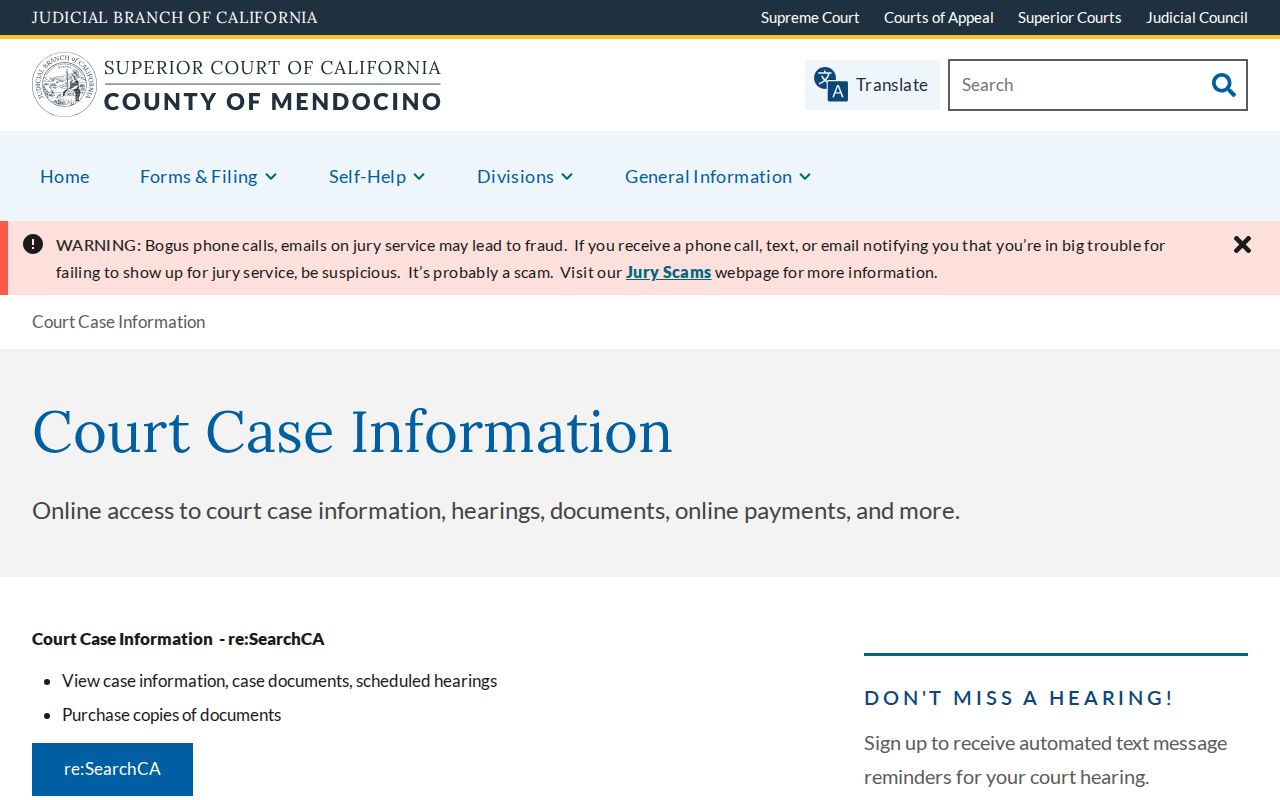
Use the portal as a starting point, but remember that remote public access to criminal case detail may be restricted. A courthouse kiosk or records request may be needed for the actual release order, minute order, or sentencing document.
How to Confirm a Court Release
Use the court when the question is why a person was released, what sentence was imposed, whether probation follows, or whether the case remains pending. Use the sheriff when the question is the physical time and manner of release from jail. Use CDCR, BOP, or ICE only when the court or booking record points to those systems.
- Start with the Mendocino Superior Court portal and re:SearchCA to find the case, hearing, or document if access is allowed.
- Use the Case Index to find the case number when possible. The research says using the case number can avoid the $15 clerk search fee required when the clerk must search by name.
- If the public cannot view criminal detail remotely, use public courthouse kiosks in Ukiah or Ten Mile/Fort Bragg for non-confidential criminal cases.
- For copies, use the court records request process by mail or in person. Phone requests are not accepted according to the research.
- Compare the court order with the jail release record, VINE alert, or NextRequest response to confirm that the legal order and physical release both occurred.
| Court record | Release question it can answer |
|---|---|
| Minute order | Whether the court ordered release, changed bail, sentenced time served, or set later hearings. |
| Sentencing order | County jail term, probation, mandatory supervision, CDCR commitment, credits, or sentence completion context. |
| Probation order | Terms after release and whether county Probation is the supervision agency. |
| Dismissal or resentencing order | Why custody may have ended or changed after the original booking. |
Court Records and Contact
The court has explicit contacts, hours, fees, and request rules. Use the criminal clerk for criminal case routing and the records request address for copies. Use the sheriff's records process separately for booking and jail release records.
Ukiah Criminal Clerk
Mendocino County Courthouse
100 North State Street, Room 107
Ukiah, CA 95482
707-463-4661
Public counter and telephone hours: 8:30 AM to 3:30 PM.
Ten Mile Branch
700 South Franklin Street
Fort Bragg, CA 95437
Public counter and telephone hours: 8:30 AM to noon and 1:00 PM to 3:30 PM.
Court Records Mail
Superior Court of California, County of Mendocino
100 North State Street, Room 108
Ukiah, CA 95482
Allow 30 days for processing according to the research.
Fee details are specific: $15 record-search fee per name search when the clerk must search for the case number, $0.50 per page copy fee, and $40 certification per document plus copy fees. Checks should be payable to Mendocino County Superior Court. The court says not to mail cash and to include a self-addressed stamped envelope.
About Mendocino Superior Court
The Superior Court is not a custody facility, but it is the core post-custody record source. It maintains electronic case records, uses re:SearchCA, and provides public courthouse kiosks for non-confidential criminal cases that nonparties cannot remotely view. That local access rule is a major Mendocino-specific detail because it explains why a user may find a case exists online but still need to visit Ukiah or Ten Mile/Fort Bragg for criminal details.
Daily calendars can help explain timing, but they are not release records. The research says calendars are updated at 6 PM for the next business day and show party or defendant name, hearing type, and hearing time. Criminal calendars include infraction traffic and non-traffic cases, but open unfiled misdemeanor or felony cases will not appear. A calendar may show that a hearing happened; it does not prove that the jail processed release. Use the minute order or jail/VINE record for that.
Expungement and dismissal effects should be handled carefully. Court relief may affect how a conviction appears and public access to some case information. Sealed or confidential matters may not be publicly viewable. But dismissal or expungement does not automatically rewrite the historical fact of a jail booking or remove every booking image or release trace from every source. Do not promise removal; use official court and agency channels for current access rules.
Court, Jail, and Supervision Boundaries
The court, jail, and supervision agencies answer different parts of the same release question. The sheriff confirms booking, physical custody, and time and manner of release from the jail. The court confirms the legal order, disposition, sentence, probation terms, bail status, dismissal, or transfer. Probation confirms local supervision where disclosure is appropriate. CDCR confirms state-prison custody and parole paths. BOP confirms federal sentenced-inmate custody. ICE confirms immigration custody. Keeping those systems separate prevents a current-custody roster from being mistaken for a complete release archive.
Court and release records should be used to verify public custody and case events. Court records can be incomplete online, limited by access rules, updated after later orders, or sealed by law. Verify with the court or originating agency before relying on a release-related record.
Mendocino Superior Court's access rules are central to released-inmate research because criminal records are not fully open to nonparty remote viewing. The court says public kiosks in Ukiah and Ten Mile/Fort Bragg allow access to non-confidential criminal and other restricted case types. A person may be out of jail, off the booking view, and still have a court file that explains the release order, sentence, probation term, resentencing, or later warrant.
Use the case index when possible because the court says documents are organized by case number and a case number can save the record-search fee when the clerk would otherwise have to search. For copies, requests may be made by mail or in person, not by phone, and the court asks for full identifying details.